My research projects in reverse chronological order. My full publication list
is available in the CV section.
Click on the
images
for more details.
Ongoing: Meso-scale Simulations of Multiphase Accretion Flows onto Supermassive Black Holes
Current state-of-the-art numerical simulations of galaxies
are largely successful at recreating the accretion flows morphology observed, especially on the
galaxy-scale (~0.1 to hundreds of kpc) and the event-horizon-scale (~10^-2 pc). However, our
current theoretical understanding of the accretion dynamics between the Bondi radius and the outer
edge of the accretion disk (the meso-scale) lags behind observations. My thesis project aims to
provide theoretical explanations for the observed meso-scale accretion flows. To achieve this goal,
I run galaxy-scale MHD simulations of the accretion flow and relativistic jet feedback motivated by
observations of the elliptical galaxy M87 using the adaptive mesh refinement code Athena++. Then,
through a nested zoom-in technique, I perform meso-scale simulations of the same
system to study the detailed physics of the accretion flow. These simulations will ultimately
provide boundary and initial conditions at the horizon-scale for future GRMHD simulations as well as
more accurate subgrid models for cosmological simulations.
Look out for our first paper coming soon to the arXiv in November!
Advisor: Yuan
Li (UMass Amherst)
Segmentation of Current Sheets in Magnetized Plasma Turbulence with Computer Vision
Magnetohydrodynamical (MHD) turbulence is a ubiquitous phenomenon in the universe. The intermittency
in plasma
turbulence causes the formation of current sheets -- two-dimensional sheet-like structures of
intense current
flows. The magnetic field across these sheets usually experiences a reversal in polarity. Through
tearing-mode
instability, current sheets are disrupted, leading to magnetic reconnection, which is responsible
for heating
the plasma and accelerating particles. As a Pre-doctoral Fellow at the Center for Computational
Astrophysics, I developed a machine learning framework, aweSOM, to automatically segment and track current sheets in 3D plasma
simulations based on the self-organizing map technique.
We find that in many test cases, the algorithm can effectively segment the current sheets from
simulations.
We recently published both the science paper in ApJ Letters: 2025ApJ...985L..31H, and the package in the Journal of Open Source
Software: 2025JOSS...10.7613H
Advisors: Joonas Nättilä, Jordy Davelaar, and Lorenzo
Sironi (CCA / Columbia University)
Measuring Turbulence in the Interstellar Medium with Young Stars
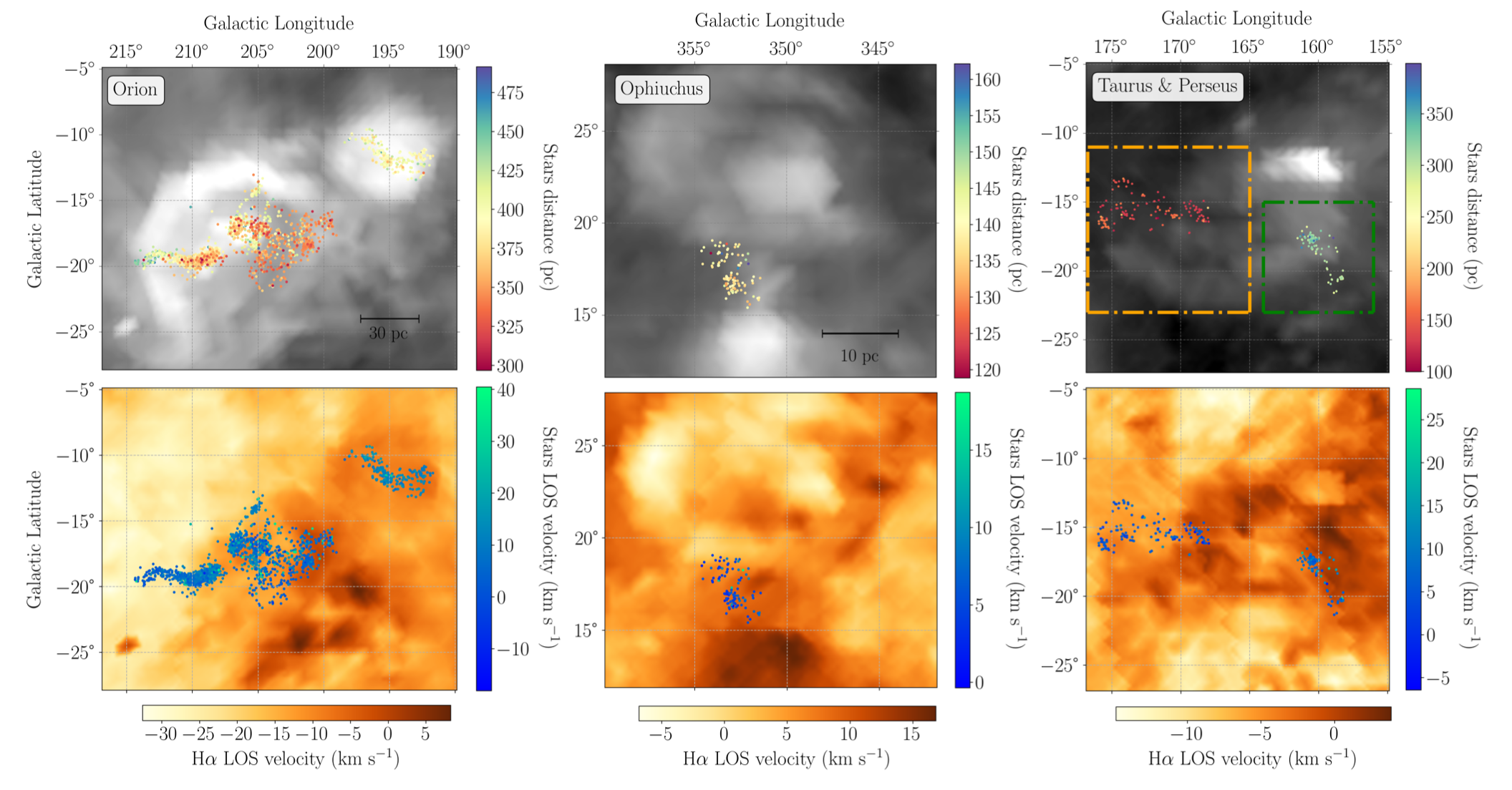
Stars are born out of the turbulent molecular gas of the interstellar medium. Once formed, they
decouple
from the surrounding gas, but still retain their pre-natal kinematics. Using Gaia astrometric
measurements in conjunction with APOGEE-2, we calculate the velocity structure function of stars in four
nearby star-forming regions and compare them to the structure functions found in Hα and CO
gas.
In our 2022 paper, we found that the structure functions of the four
star-forming regions in the Solar neighborhood shows a universal scaling of turbulence when traced
by young stars. We also found evidence of local supernova energy injection in Orion and Ophiuchus,
which is supported by observational studies.
This work is a follow-up to our 2021
paper, which investigates young stars in the Orion Complex specifically.
Read our
press release here. Watch our interview for the American Astronomical Society's
Journal Author Series here.
I also mentored a post-baccalaureate student, Benjamin Velguth, who recently
published a follow-up work, examining the role of turbulence, gravity, supernovae,
and magnetic fields in star formation through stellar kinematics.
Advisor: Yuan Li (UMass Amherst)
Weak Emission-Line Quasars (WLQs) in the Context of C Ⅳ Emission-line Properties
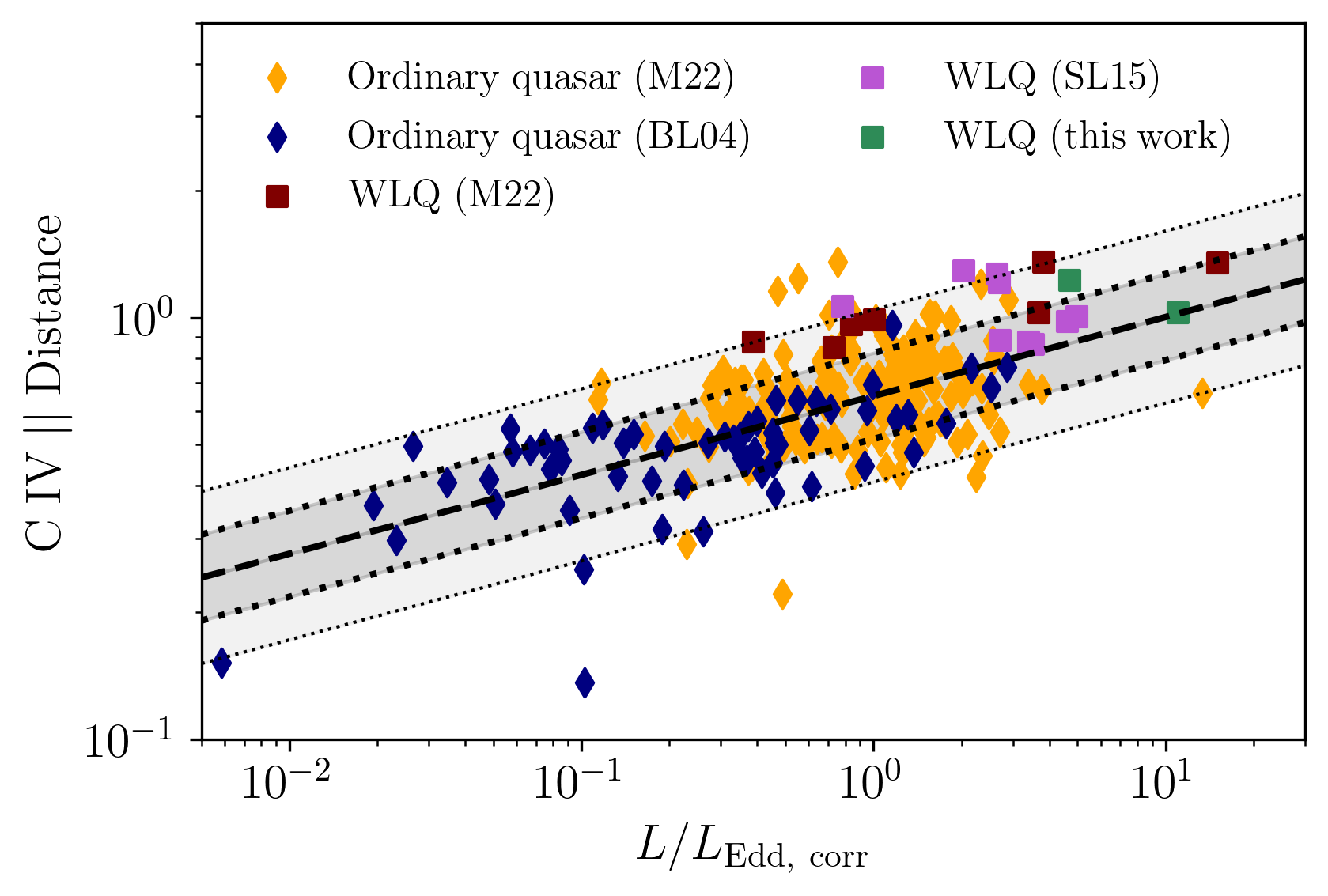
WLQs are a peculiar subset of luminous active galactic nuclei whose emission spectra show extremely
weak
emission line profiles of Lyα+N V λ1240 and/or C IV λ1549. Much effort has been
invested to explain the weakness in emission profiles of these quasars over the last two decades. My
current
project proposes a new way of looking at WLQs not as a disjoint subset of quasars but rather as
quasars that
lie preferentially towards the extreme end of the C IV
|| Distance parameter space.
Read our paper: 2023ApJ...950...97H.
Advisor: Ohad Shemmer (UNT)
Similarity Mapping of the Milky Way Using Neural Style Transfer
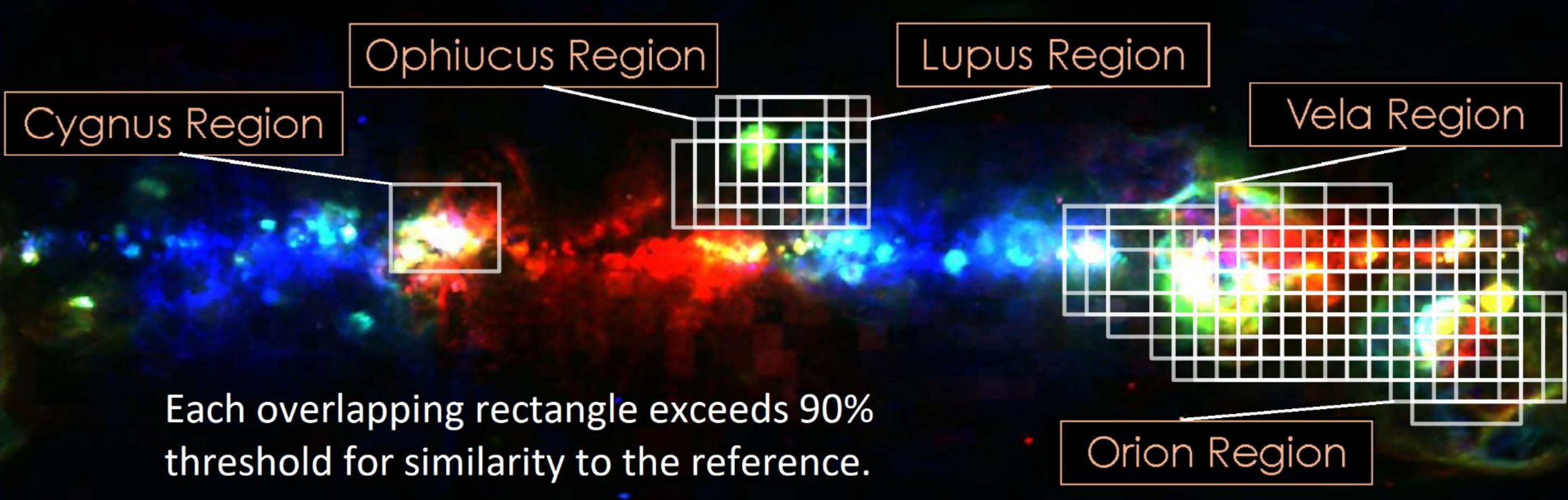
As a graduate student advisor, I helped M.S. students in the A.I. summer program at UNT apply the
pre-trained VGG-19 deep neural network architecture to the Milky Way map from the
Wisconsin H-Alpha Mapper
survey. Using the Orion Molecular Cloud Complex as a reference image, neural style transfer was able
to identify various star-forming regions in the Milky Way. This result shows neural style transfer's
promise as a quick targets identification pipeline for future sky surveys.
Read our project
summary poster here.
Advisors: Mark Albert and Yuan Li (UNT - now at UMass)
Generating Initial Data for Binary Neutron Stars Merger Simulations
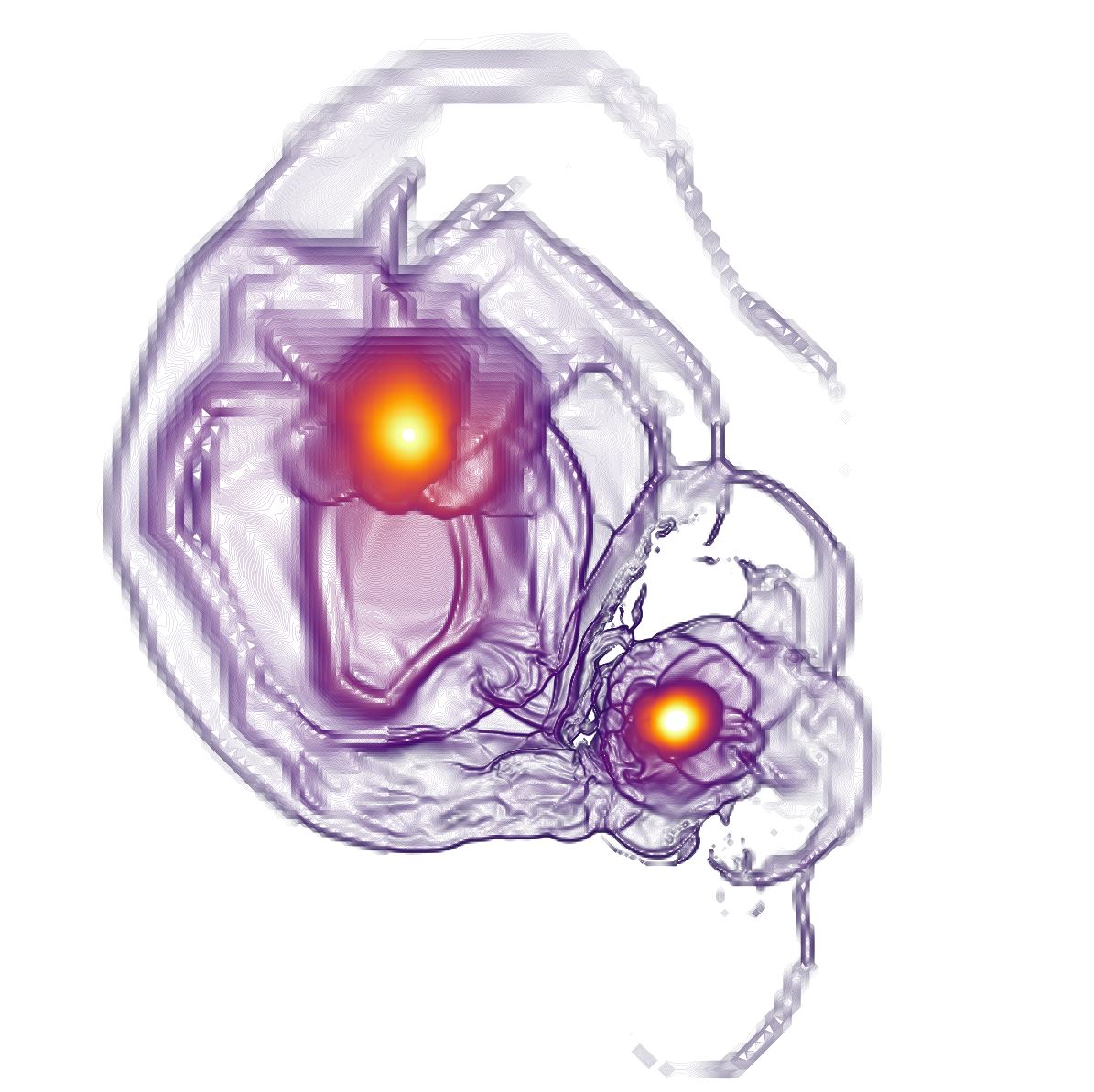
I worked as an undergraduate research student at the Rochester Institute of Technology's Center for Computational Relativity and
Gravitation from 2018 to 2020. There, I modified and documented the LORENE initial data code to generate
physically motivated binary neutron stars pre-merger. Furthermore, I performed several GRMHD
simulations of binary neutron stars merger using the Einstein Toolkit, and reported our findings at the 2019 Midwest
Relativity Meeting in Grand Rapids, Michigan.
Read our conference presentation here.
Watch one of my simulations here.
Advisors: Joshua Faber
(RIT) and Eric Blackman
(UofR)